Competitor Analysis That Actually Helps You Win
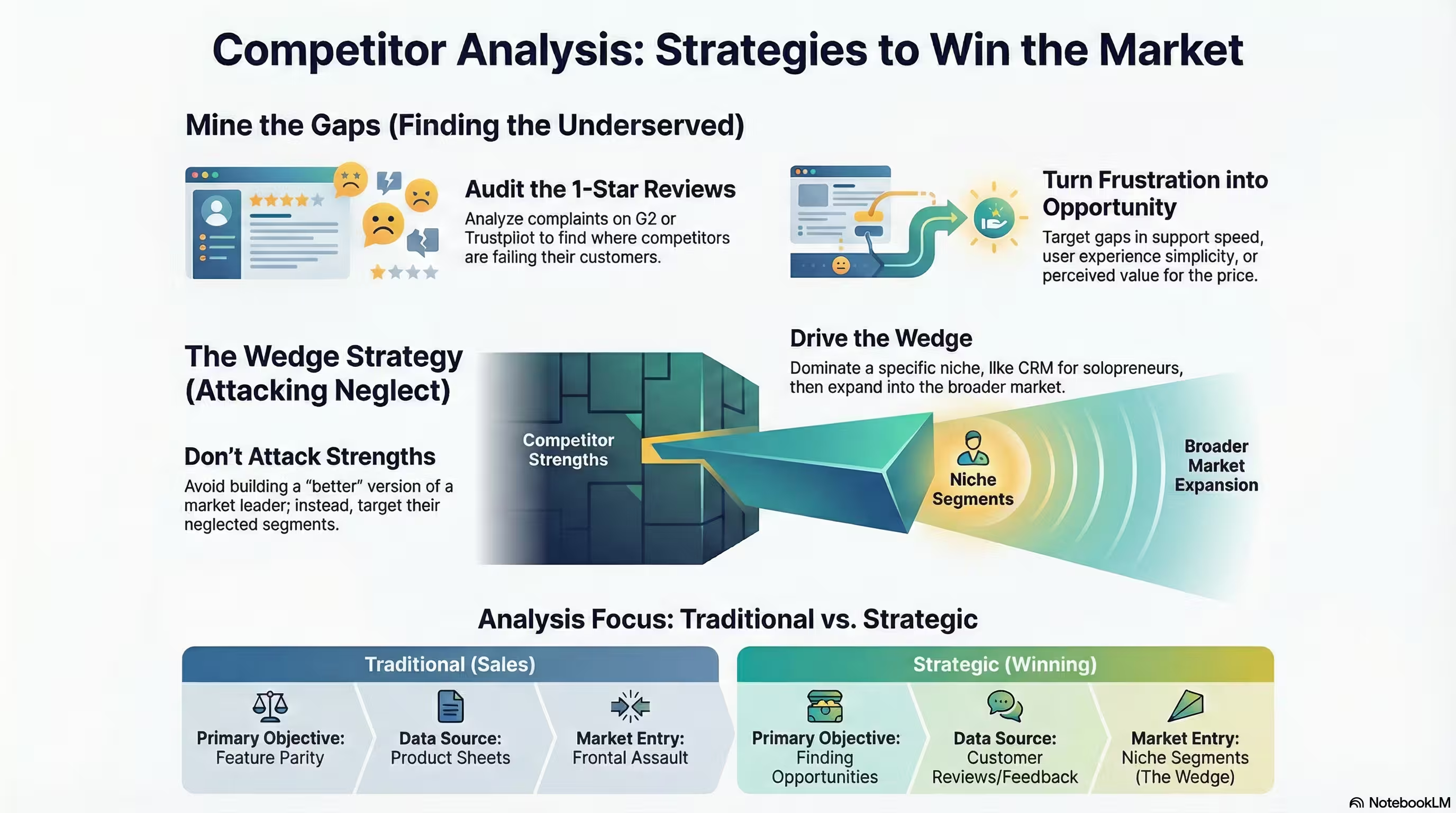
Click on image to enlarge
Feature tables are for sales sheets, not strategy. To beat competitors, you need to understand their business model, their distribution channels, and their weak spots. A checkmark next to "has dark mode" won't win you the market.
Most competitor analysis is a ritual: founders build a spreadsheet, list features, add green checkmarks, and conclude they can win by "building more." But markets don't reward feature volume. Markets reward positioning, distribution, and focus.
Competitors are not just products - they're systems. They have revenue models, customer acquisition loops, onboarding flows, switching costs, and internal incentives that shape what they will (and won't) do. The goal of competitor analysis is not to copy. It's to find what they systematically neglect.
Look for the Underserved
Where are customers complaining? Go to G2, Capterra, or Trustpilot. Read the 1-star and 2-star reviews of your biggest competitor. What are people angry about?
- "Their support takes 3 days to reply." -> Opportunity: Speed/Service.
- "It's too complicated for my small team." -> Opportunity: Simplicity/UX.
- "It's too expensive for what it does." -> Opportunity: Price/Value.
Reviews are the market's raw truth. People complain when expectations are broken. And broken expectations reveal the gaps incumbents struggle to fix - not because they're stupid, but because they're optimized for something else.
How to extract opportunity from reviews
- Group complaints: support, UX complexity, missing workflows, pricing, integrations.
- Identify the "why": Is the complaint about effort, risk, or money?
- Spot the segment: Who is complaining? SMB? enterprise? solo founders? regulated industries?
- Map to a wedge: Can you build a product that is explicitly designed for that segment's pain?
The best wedges are born from patterns: the same complaint repeated across multiple customers, across multiple platforms, across time. That repetition is demand. Your job is to turn demand into a position.
Don't Attack Strength, Attack Neglect
If your competitor is Salesforce, don't try to build a "better Salesforce." You will lose. Instead, find the segment they neglect. Maybe it's "CRM for solopreneurs" or "CRM for mobile notaries."
That is your wedge. Drive it deep, crack the market open, and expand from there.
Why incumbents neglect segments
- Pricing pressure: Small segments don't justify enterprise sales costs.
- Complexity cost: Supporting niche workflows increases support and product complexity.
- Incentives: Sales teams sell what maximizes commission, not what best serves a niche.
- Roadmap politics: Loudest big customers shape the product; small ones get ignored.
Your advantage is focus. Startups can obsess over a niche workflow and deliver a product that feels "made for me." Incumbents struggle to do that because they are built for broad coverage.
The Competitor System Map
To analyze competitors in a way that actually helps you win, map them as systems:
Business Model
Pricing, packaging, ACV, upsells, contract length, services dependency. This reveals who they truly optimize for.
Distribution
SEO, outbound, partnerships, communities, marketplaces, product-led loops. This reveals where they are strong and where they are blind.
Positioning
Who they target, what promise they make, what they avoid talking about. Positioning reveals the narrative they can't escape.
Weakness Pressure
Where users complain, where churn happens, where integrations fail, where support breaks - these are entry points.
Once you map the system, your strategy becomes obvious: you don't need to beat them everywhere. You only need to beat them where they can't respond quickly.
Three Winning Competitor Plays
1) The Speed Play
Out-execute them in support and iteration cycles. If customers complain about slow responses, make speed your brand. Fast feedback loops build trust. Trust reduces churn and increases referrals.
2) The Simplicity Play
Incumbents accumulate complexity. Build a product that is intentionally smaller but dramatically easier. Simplicity is not "less powerful." It's more usable for the right segment.
3) The Pricing Integrity Play
Many markets are overpriced for SMB and under-served for mid-market. Use transparent pricing and clear packaging to capture buyers who hate negotiation and bloat.
Idea Kill Switch Standard
Competitor analysis isn't about listing features. It's about finding a wedge the incumbent cannot defend without breaking their incentives, pricing, or product complexity.
A Practical Competitor Analysis Checklist
- Who is their true buyer? (not their user)
- How do they acquire customers? (and what makes it expensive?)
- What do reviews complain about repeatedly? (patterns, not anecdotes)
- What segment do they ignore? (SMB, niche workflow, new channel)
- If they copy your features, do you still win? (distribution, workflow, data, trust)
When you do this properly, competitor analysis becomes a strategy engine. It tells you where to focus, what to ignore, and how to win without fighting a giant head-on.
Keep Reading
- TAM Is a Vanity Metric -why market sizing alone won't help you win
- The Brutal Truth About Product-Market Fit -real PMF signals vs. vanity metrics
- How to Validate Your Startup Idea in 30 Minutes -get your competitive landscape analyzed
Get a competitor deep-dive for your idea
See a real startup idea validation demo with competitor context, wedge suggestions, and strategy risks.