How to Validate Your Startup Idea in 30 Minutes
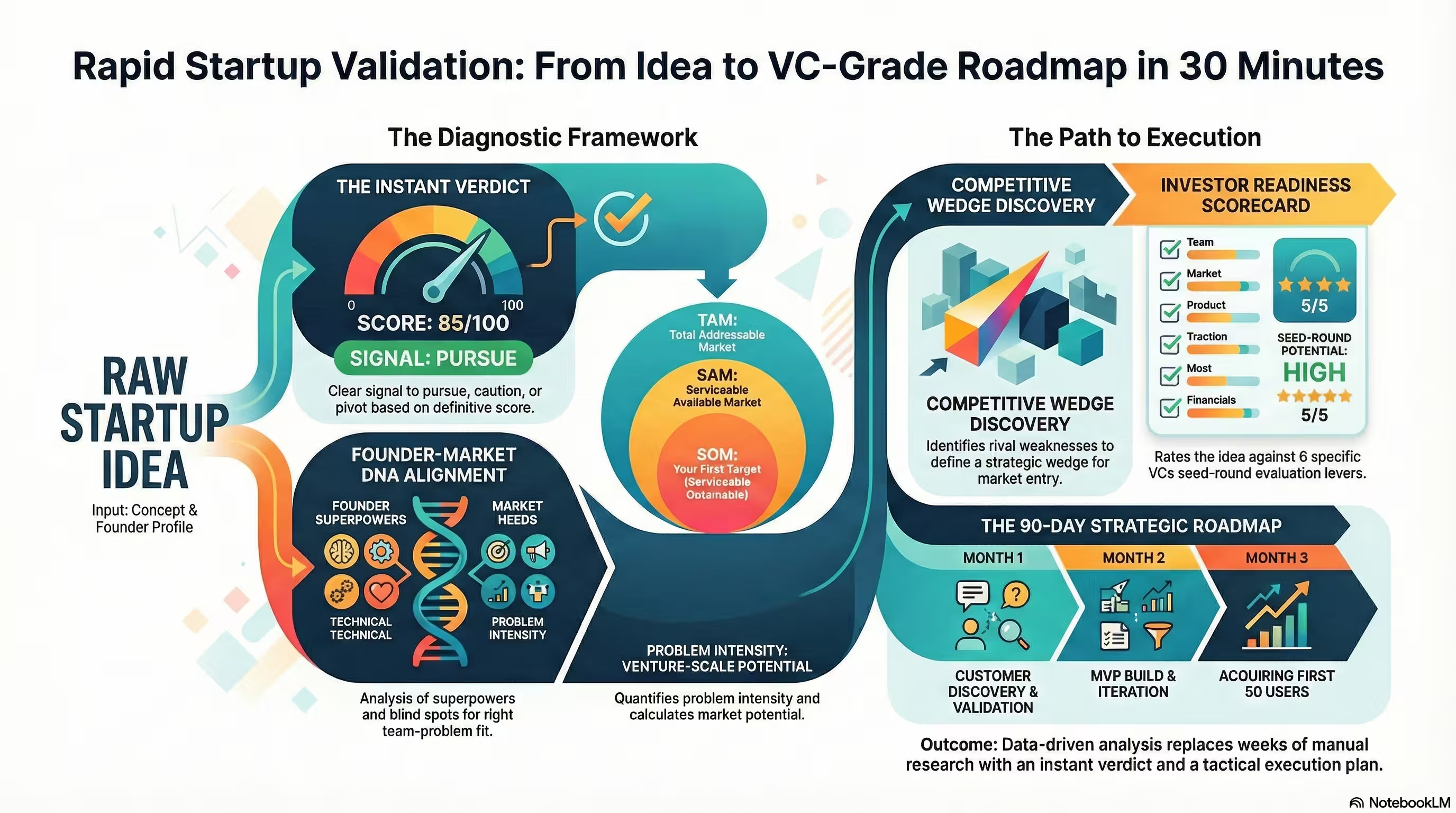
Click on image to enlarge
Validating a startup idea traditionally takes weeks. You build landing pages, run ads, interview strangers, and compile messy spreadsheets. But what if you could get a comprehensive, VC-grade analysis in the time it takes to drink a coffee?
Most founders don't fail because they can't build. They fail because they build the wrong thing for the wrong people at the wrong time. Validation is the discipline that prevents that. The catch is that manual validation is slow, emotionally draining, and easy to do incorrectly. That's exactly why Idea Kill Switch exists.
Idea Kill Switch replaces the guesswork with structured analysis. Our AI-driven flow takes you from uncertainty ("Is this even good?") to clarity ("Here is what to do next - and why.") in minutes, not weeks.
What "30-minute validation" actually means
It does not mean you will have perfect certainty. It means you will get an evidence-based read on your idea's structural strength, identify the biggest risks, and walk away with a prioritized plan - before wasting months building.
1. The Verdict: Instant Gratification
We start with the answer. No fluff. If the idea is structurally weak, you should know immediately. If it's strong, you should know what makes it strong - and what could still kill it.
- Visual Score (0-100): A definitive number quantifying your idea's potential based on multiple weighted signals.
- Recommendation: A clear signal to PURSUE STRONGLY, PROCEED WITH CAUTION, or PIVOT RECOMMENDED.
- The "One-Liner": A concise summary of why (e.g., "Strong pain and timing, but distribution is the risk").
This matters because most founders spend months before they allow themselves a verdict. By then, sunk cost takes over and rational decisions become hard.
2. Your Founder DNA
Great ideas fail with the wrong founders. That's not a motivational quote - it's a pattern. Some markets reward engineering excellence. Some markets reward sales. Some markets punish solo founders. We analyze you as much as the idea to measure founder-market fit.
- Founder-Market Fit Score: Are you the right person to solve this?
- Superpowers & Blind Spots: Unfair advantages and likely skill gaps (e.g., "Strong tech, weak distribution").
- Execution style: Do you tend to ship fast, or polish forever? The wrong style can kill timing.
Why this is important
Investors don't just fund markets. They fund people who can survive the market's reality. Founder-market fit is the single best predictor of whether the founder keeps going when it gets hard.
3. The Problem Landscape
We validate the pain before the solution. Most founders do the reverse: they fall in love with a product and then hunt for a problem. That is backwards.
- Severity Score: Is this a "hair on fire" problem or a mild annoyance?
- Jobs-to-be-Done: What are people currently doing to solve this? (workarounds and alternatives)
- Evidence: Real links to discussions where people complain about this right now.
The key question is not "Do people say it's a problem?" but "Do people behave like it's a problem?" Real pain creates behavior: budgets, workarounds, hacks, manual processes, and urgency.
4. Market Opportunity (The Investor View)
Is the market big enough to support a venture-scale business? And more importantly: can you win a wedge fast enough to survive? We frame market sizing around survivability, not vanity.
We also analyze CAGR (growth rate), market maturity, and "Why now?" drivers - the real catalysts that create tailwinds.
5. The Competitive Battlefield
You are never alone. We map the landscape so you can find your wedge. Competition is not the enemy - confusion is.
- Competitor Density: High, Medium, or Low?
- Top Rivals: Cards with their strengths, positioning, and likely strategy.
- Your Wedge: Strategic recommendation on where to attack (underserved niche, pricing gap, workflow neglect).
What a wedge looks like
It's a segment the incumbents ignore, a use case they handle poorly, or a buyer who is overpaying for a bloated product. The wedge is how you win without being "bigger."
6. Solution & Product Validation
Does your specific approach make sense? Differentiation must translate to switching behavior. If users won't switch, your "unique features" are just engineering art.
- Differentiation: Why will users switch? (UX, Price, Tech, Brand)
- Moat Assessment: How defensible is this over time? (Network effects, IP, Data)
- MVP Roadmap: Prioritized list of features for your first version
7. Go-To-Market Reality Check
"If you build it, they will come" is a lie. Distribution is a system. We rank acquisition channels based on feasibility, cost, and fit with your founder DNA.
Channel Strategy
We identify likely channels (SEO, Outbound, Partnerships, Communities, Product-led loops) and flag the biggest execution risks: high CAC, long sales cycles, weak conversion, or dependence on paid ads too early.
8. Business Model Viability
Math helps. We break down the unit economics and pricing power. If the model doesn't work, growth only accelerates losses.
- Revenue Model: Subscription, usage-based, transaction fee, services, or hybrid
- Pricing Power: Budget, Mid-market, or Premium
- LTV:CAC Ratio: A projection of fundamental business health
9. Risk Map & De-Risking
We plot risks on a heat map (Likelihood x Impact) across Market, Execution, Regulatory, and Team risks. For every red flag, we provide a mitigation strategy - not vague advice.
10. Investor Readiness Scorecard
Raising capital? We rate you on the levers VCs care about: Team, Problem, Market, Solution, GTM, and Business Model. Then we tell you exactly what's missing - so you can fix it before pitching.
11. Strategic Roadmap (Your Next 90 Days)
We don't leave you hanging. The analysis concludes with a phased plan designed to reduce risk quickly. The goal is not to "build more." The goal is to learn the right things in the right order.
- Phase 1 (Weeks 1-4): Validation & Customer Discovery
- Phase 2 (Weeks 5-12): MVP Build & Tech Stack
- Phase 3 (Weeks 13-20): First 50 Customers
Keep Reading
- Why 90% of Startup Ideas Fail Before Launch -the structural weaknesses we detect most often
- TAM Is a Vanity Metric -what market signals actually predict success
- Competitor Analysis That Actually Helps You Win -find your competitive wedge
Start Your Analysis Today
Don't spend months wondering. Get the answers in minutes.