The Brutal Truth About Product-Market Fit
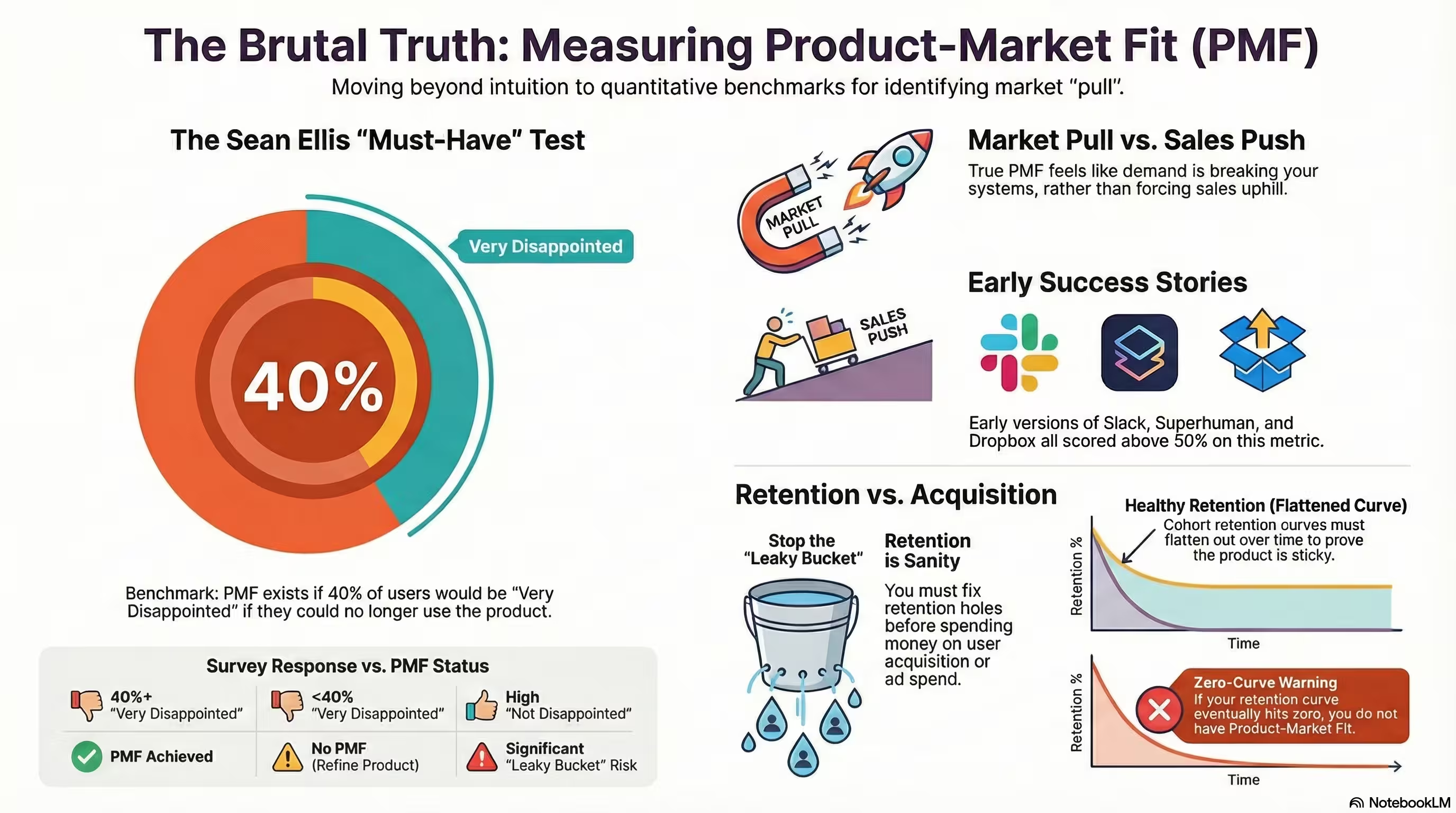
Click on image to enlarge
Product-Market Fit (PMF) is when the market pulls the product out of you. It feels like everything is breaking because you can't keep up with demand. If you're "pushing" sales uphill, you don't have it. And the brutal truth is that most founders confuse early excitement with PMF - then wonder why growth stalls.
PMF is not a vibe. It's not "people liked my demo." It's not "our onboarding feels smooth." PMF is a repeatable reality: customers consistently adopt, pay, and stay - and your growth starts being limited by your ability to deliver, not your ability to convince.
The dangerous part is that almost-PMF looks like PMF from the inside. A handful of users love you, a few tweets pop off, some friends say "this is sick," and you mistake signal for scalability. PMF isn't about having fans. It's about having a market that behaves predictably.
PMF in one sentence
You have Product-Market Fit when a clearly defined customer segment would be meaningfully worse off without your product - and they prove it through retention, usage intensity, and willingness to pay.
The Sean Ellis Test
Sean Ellis, the growth hacker who coined the term, has a simple survey question that predicts PMF better than any other metric:
"How would you feel if you could no longer use this product?"
The benchmark is 40%.
If 40% or more of your users answer "Very Disappointed," you have PMF. Slack, Superhuman, and Dropbox all scored above 50% in their early days.
The reason this works is simple: the question forces a binary emotional truth. "It's nice" becomes irrelevant. Users either need it or they don't. And "need" is what creates retention, referrals, and willingness to tolerate imperfect UX.
How to run the Sean Ellis test correctly
- Survey the right segment: Active users who've had enough time to experience the core value.
- Don't mix segments: If power users and casual users are blended, the score becomes noise.
- Ask follow-ups: "What type of people would most benefit?" and "What's the main benefit you receive?"
- Look for clarity: If "very disappointed" users describe wildly different benefits, your product value isn't focused yet.
One more brutal point: a low Ellis score is not a failure. It's a diagnosis. It means you don't have PMF yet - and now you know what to fix.
Retention is the Ultimate Metric
Acquisition is vanity. Retention is sanity. Look at your cohort retention curves. Do they flatten out? If your curve goes to zero eventually, you are building a leaky bucket. Fix the holes before pouring more water (ad spend) in.
Retention reveals whether your product creates ongoing value or a one-time curiosity. People try new tools all the time. They keep the ones that become part of their workflow.
What "good" retention looks like
It depends on the product type, but the shape matters more than the number:
- Flattening curve: After an initial drop, retention stabilizes - users form a habit.
- Usage depth: Retained users do the core action frequently and meaningfully.
- Segment strength: One segment retains much better than the rest - that's your wedge.
If you're building SaaS, retention is often visible in these proxies: recurring logins, recurring workflows completed, integration usage, collaboration actions, or repeated "aha moments" that correlate with renewal.
PMF is usually not "everyone loves it." It's "a specific segment can't live without it." Your job is to find that segment, understand what they truly value, and then build around that value.
The 4 Stages Founders Confuse With PMF
Stage 1: Novelty
People try your product because it's new. They sign up. They click around. They disappear. This is not PMF - it's curiosity.
Stage 2: Hobbyist Love
A small group loves it deeply, but they are not a market with budgets. They are a community with opinions. If they won't pay and the segment can't expand, you have fans, not PMF.
Stage 3: Founder-Led Sales
You close deals through sheer hustle. You push every sale uphill with demos, custom work, and persuasion. That can be valuable learning - but if it doesn't become repeatable, it's not PMF.
Stage 4: Early Traction
Some growth appears, but churn remains high. It feels like PMF because metrics rise. Then the top of funnel saturates and everything slows. Without retention, growth is just replacing churn.
The PMF Scorecard (Operator Version)
If PMF is measurable, what do you measure? Here's the operator's scorecard:
- Very Disappointed >= 40%: A strong indicator (when segmented correctly).
- Cohort retention flattens: Users form a habit.
- Usage intensity increases over time: Power users deepen usage.
- Organic growth: Referrals, word-of-mouth, inbound demand.
- Willingness to pay: Not "would you pay," but actual payments or strong commitments.
- Sales friction decreases: The pitch becomes simpler; the buyer "gets it" faster.
Idea Kill Switch Standard
PMF is not a milestone you declare. It's a state the market proves. When your retention and demand signals align, you're not "ready to scale" - you're forced to scale.
What To Do If You Don't Have PMF Yet
Most companies don't have PMF early. That's normal. The mistake is scaling anyway. If PMF isn't there, your job is to reduce uncertainty systematically:
- Narrow the segment: Identify the users with highest retention and focus there.
- Clarify the core value: What is the one job-to-be-done you win reliably?
- Improve activation: Make the "aha moment" happen faster and more reliably.
- Fix churn drivers: Interview churned users. Find patterns. Remove friction.
- Collect payment signals: Paid pilots, deposits, or simple pricing tests.
PMF is often a sequence of small wins: the right segment, then clear value, then habit, then willingness to pay. When those align, growth becomes a consequence - not an objective.
Keep Reading
- How to Validate Your Startup Idea in 30 Minutes -get structured validation before you scale
- Why 90% of Startup Ideas Fail -spot failure patterns before they cost you
- Investor Readiness Scorecard -prove PMF to investors with evidence
Validate PMF risk before you scale
Run a startup idea validation and get a reality check on segment, willingness to pay, and distribution feasibility.