Why 90% of Startup Ideas Fail Before Launch
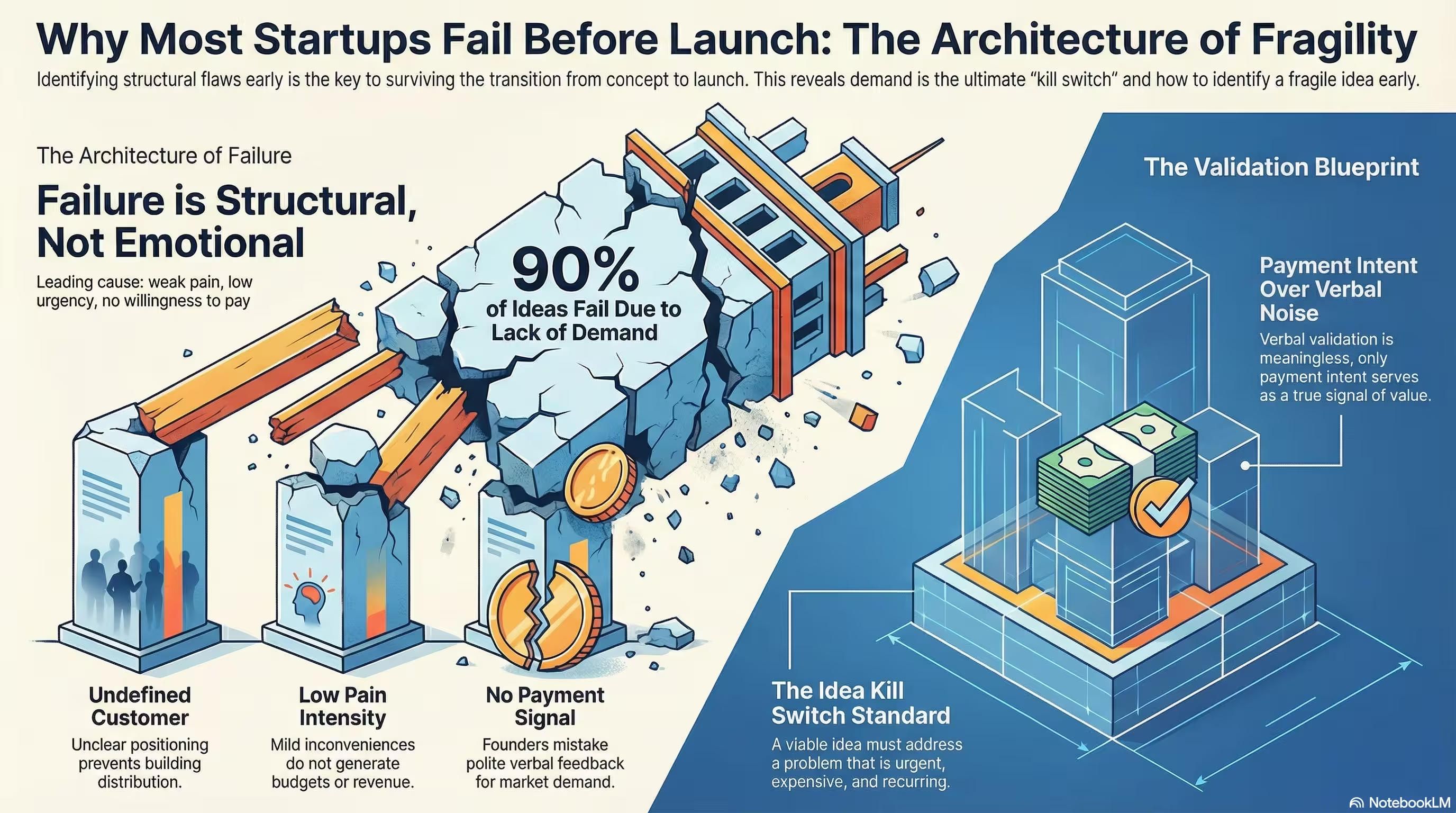
Click on image to enlarge
After analyzing hundreds of startup concepts, one pattern is clear: most ideas fail before they ever meet the market. Not because founders are lazy, not because they lack talent, and not because the product "isn't polished enough." They fail because the idea is structurally weak - built on assumptions that never get tested.
There is a myth in startup culture that execution is everything. Execution matters, but it only compounds what already exists. If the underlying demand is weak, execution amplifies nothing. You can build faster, ship cleaner, and market harder - and still fail, because the market never cared.
In other words: most startup failures are not accidents. They are predictable outcomes. The warning signs show up early, but founders ignore them because building feels productive and validation feels uncomfortable.
Failure Is Structural, Not Emotional
Founders assume the bottleneck is product. In reality, the bottleneck is validation. The majority of failed startups were structurally weak from day one: unclear buyer, weak urgency, and no reliable path to distribution.
The leading cause of startup death is not competition. It is lack of demand. Weak pain. Weak urgency. Weak willingness to pay. When those three are missing, your "market" is a fantasy.
Think of it like engineering: if the foundation is cracked, adding floors doesn't fix it. You can redesign the UI, switch frameworks, raise a seed round - but the crack stays. Great founders don't just execute. They stress-test the foundation until they can trust it.
Idea Kill Switch Standard
If the problem is not urgent, expensive, and recurring - the idea is fragile. If the buyer cannot describe the pain in one sentence and explain the cost of doing nothing, you don't have demand.
"Urgent" means the buyer wants it solved now - not "someday." "Expensive" means the pain already has a budget (money, time, risk, or reputation). "Recurring" means the pain comes back repeatedly, creating a reason to keep paying.
If you're building a nice-to-have, your only weapon is persuasion. If you're building a must-have, the market persuades itself.
The 3 Structural Weaknesses We Detect Most Often
1) Undefined Customer
Broad segments signal unclear positioning. "Small businesses" is not a customer. "Busy professionals" is not a customer. If you cannot name your exact buyer, you cannot build distribution - because distribution is built on specificity.
The fastest way to detect this weakness is simple: ask a founder to complete the sentence: "My product is for ___ who struggle with ___ when trying to ___." If they cannot finish it without using generic words, the customer is undefined.
When the customer is undefined, everything becomes fuzzy: messaging becomes vague, features become random, and acquisition becomes expensive. Your product turns into a "platform" because you can't commit to one job-to-be-done.
Reality check
If you can't list 10 people you could message today who match your ideal buyer profile, your customer is not defined yet. Start narrower than you think.
2) Low Pain Intensity
Mild inconvenience does not generate revenue. High pain generates budgets. Most ideas are built around "annoyances" - friction that users tolerate because it's not costly enough to change.
The market pays for one of four things: saving time, making money, reducing risk, or increasing status. If your problem does not map clearly to at least one of these, willingness to pay will be weak.
Many founders confuse "people agree it's a problem" with "people will pay to solve it." Users will politely validate almost anything in a conversation. They validate because it costs them nothing to say "yeah, that would be useful."
How we test pain intensity
- Frequency: How often does the pain occur?
- Cost of delay: What happens if nothing changes for 30 days?
- Workarounds: What do they do today to solve it (tools, manual processes, hiring)?
- Budget ownership: Who signs the check and why?
If there are no serious workarounds, that's often a signal the pain isn't painful. Real pain creates behavior. It forces people to hack solutions, buy alternatives, or allocate internal resources.
3) No Payment Signal
Verbal validation is noise. Payment intent is signal. The easiest way to avoid building a dead product is to chase signals that are costly for the buyer: deposits, pre-orders, signed LOIs, paid pilots, or even strong referral introductions.
If you ask "Would you pay for this?" you will get fake yes-es. Instead ask: "How do you budget for this today?" or "What line item does this come from?" If the conversation becomes uncomfortable, good - you're approaching reality.
Payment signal is not only money. It's any commitment with risk: a team giving you access to data, time with decision makers, a signed pilot plan, or agreeing to switch a process and stake their credibility.
The Hidden Killer: Distribution Denial
Many founders think distribution will "figure itself out" once the product is good. That's rarely true. A great product without distribution is a silent failure. The question is not "Can we build it?" but "Can we reach buyers predictably?"
Early-stage distribution is usually one of these: founder-led sales, content + SEO, partnerships, communities, or outbound. If you don't have a credible path to any of these, your idea is structurally weak - regardless of how smart the tech is.
A quick distribution test
Can you name one channel you can own and operate repeatedly, where customer acquisition cost trends down over time? If not, you are betting on luck.
Why Founders Ignore These Signs
Because building is comforting. It's measurable. It produces screenshots, commits, and dopamine. Validation is messy. It involves rejection, ambiguity, and the possibility that your idea is wrong.
The founder's ego often bonds with the idea. When the idea gets attacked, the founder feels attacked. That's the moment where rational analysis collapses and months get wasted.
Great founders separate identity from hypothesis. The idea is not "my dream." The idea is a test. If the test fails, that's not failure - that's progress.
Weak ideas die late. Smart founders kill them early.
The goal is not to "believe harder." The goal is to eliminate uncertainty fast. Build only after you have real signals.
Run Your Analysis ->A 30-Minute Pre-Build Checklist
Before you write code, answer these in plain language. If you can't, don't build yet.
- Buyer: Who exactly buys this? What is their job title and context?
- Pain: What happens if they do nothing for 30 days?
- Frequency: How often does the problem occur?
- Current solution: What do they use today and why is it failing?
- Payment signal: What commitment can you collect this week?
- Distribution: What channel can you realistically operate repeatedly?
If these answers are vague, your idea is still a story. If these answers are specific, your idea becomes a plan.
Keep Reading
- How to Validate Your Startup Idea in 30 Minutes -a step-by-step validation approach
- The Brutal Truth About Product-Market Fit -why PMF is harder than founders think
- Investor Readiness Scorecard -what VCs actually evaluate
Validate your startup idea before you build
See a real startup idea validation demo, then decide if pricing makes sense for you.