TAM Is a Vanity Metric: What Actually Matters
Click on image to enlarge
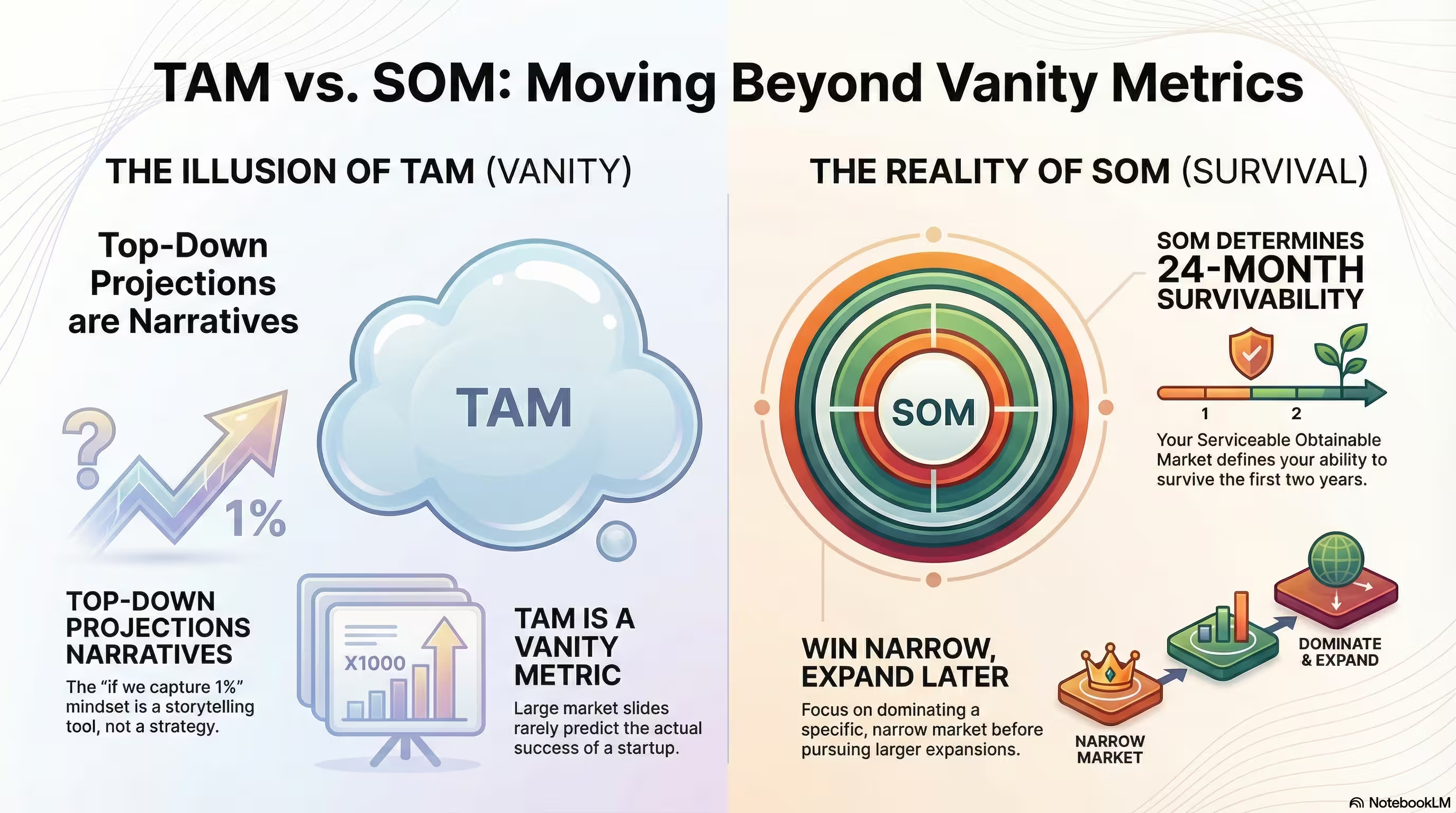
Large TAM slides rarely predict startup success. They look impressive, they feel safe, and they make founders believe they're building something "big." But TAM is often a story you tell yourself - not a constraint you can operate within.
If you’ve ever built a pitch deck, you’ve seen the template: “The market is $X billion, and if we capture 1%...” It’s a rite of passage. It’s also usually meaningless. Not because market sizing is irrelevant, but because early-stage reality is dominated by a different question: Can you reach a small group of buyers and win them consistently?
Investors don't fund TAM. They fund wedges that can expand. Operators don't win by describing big markets. They win by owning a narrow, painfully specific segment - then using momentum to expand outward.
Top-Down Projections Are Narrative Tools
Top-down market sizing (TAM) is useful for storytelling. It shows the ceiling. But it doesn't tell you whether you can climb. Early on, almost every startup is constrained by distribution, not ceiling.
The problem with top-down logic is that it hides the hard parts. "If we capture 1%" assumes:
- You can reach the right buyers.
- You can convert them at an acceptable cost.
- You can retain them long enough to recover CAC.
- You can defend your position against incumbents and copycats.
- You can expand without breaking your unit economics.
"If we capture 1%" is not a strategy. It's a motivational poster. Real strategies explain how you get your first 10 customers, then your next 100, then your next 1,000 - and why each step becomes easier, not harder.
A simple test
If your market slide doesn't change how you would build, sell, or price the product this week, it's not operational information - it's decoration.
Here's the uncomfortable truth: the best early-stage founders often don't know their TAM precisely. They know something more important: exactly who feels the pain, exactly when it happens, and exactly how people buy solutions today.
SOM Determines Survivability
Your Serviceable Obtainable Market defines whether you can survive your first 24 months.
SOM isn't "the portion of the market you can get someday." SOM is the set of customers you can realistically reach and win with your current constraints: your budget, your distribution access, your credibility, your time, and your product maturity.
Survival is math. Early-stage companies die when they can't turn effort into repeatable acquisition and retention. SOM is what determines whether you can build a repeatable loop - not whether a big market exists somewhere in the distance.
A healthy SOM has five properties:
Reachable
You can name where they hang out, how to contact them, and how they discover tools.
Painful
The problem is urgent, expensive, and recurring - with visible consequences for delay.
Budgeted
There is already a line item: money, time, headcount, or risk mitigation.
Dense
Buyers are concentrated enough that distribution gets cheaper as you learn (communities, events, networks).
Expandable
Winning this segment gives you a credible adjacent expansion path. You're not trapped in a corner niche forever.
Notice what's missing: "huge." Huge is not a property of early-stage survivability. In fact, the bigger the market, the more likely it is you'll face strong incumbents, high noise, and expensive acquisition.
Narrow markets win first. Expansion comes later.
What Actually Matters More Than TAM
If you want market signals that predict success, focus on these:
1) Buyer Clarity + Budget Ownership
Can you name the buyer? Not "users." The buyer. Who signs, who approves, who feels the pain, and who blocks purchases? If you can't answer that, your market is not defined. Your TAM doesn't help.
2) Trigger Events
Great markets have trigger events that cause buying behavior: new regulation, an audit, a funding round, hiring, a security incident, a failed deployment, a pricing change. If you can map the trigger event, you can build outbound and content around it. If you can't, your GTM becomes random.
3) Switching Costs and Workarounds
What do customers do today? If they have strong workarounds (spreadsheets, manual processes, legacy tools), that's evidence the pain is real. If they do nothing, it may be a "nice-to-have."
4) Competitive Vacuum
Counterintuitively, "competition exists" can be a good sign. It means there is money. What matters is whether there's a vacuum: a neglected segment, a pricing mismatch, a workflow that incumbents ignore, or a new distribution channel incumbents don't understand.
5) Distribution Leverage
Can you reach the market cheaply over time? SEO, community, partnerships, product-led loops, founder-led outbound - each is a different physics engine. TAM doesn't give you leverage. Distribution does.
Idea Kill Switch Lens
We care less about "how big the market is" and more about whether your wedge can achieve repeatable acquisition and retention before you run out of time, cash, or motivation.
How to Replace TAM With a Real Market Argument
If you still want a market section in your content or deck (you should), build it bottom-up and operational:
- Start with a wedge: a narrow segment with a specific pain and buying trigger.
- Estimate reachable buyers: directories, LinkedIn counts, industry lists, communities.
- Define a realistic ACV: based on budget ownership and value delivered.
- Calculate survivability: do 50-200 customers get you to stability?
- Show expansion: adjacent segments unlocked after wedge dominance.
This produces a market argument that actually guides execution. It tells you who to talk to, what to build first, how to price, and how to sell.
Keep Reading
- Competitor Analysis That Actually Helps You Win -find wedges incumbents miss
- Investor Readiness Scorecard -build a market section that VCs respect
- Why 90% of Startup Ideas Fail -structural weaknesses to watch for
Get market clarity in minutes
See a real startup idea validation demo with market sizing, competitor context, and risk flags.