Idea Kill Switch vs. ChatGPT: Validation
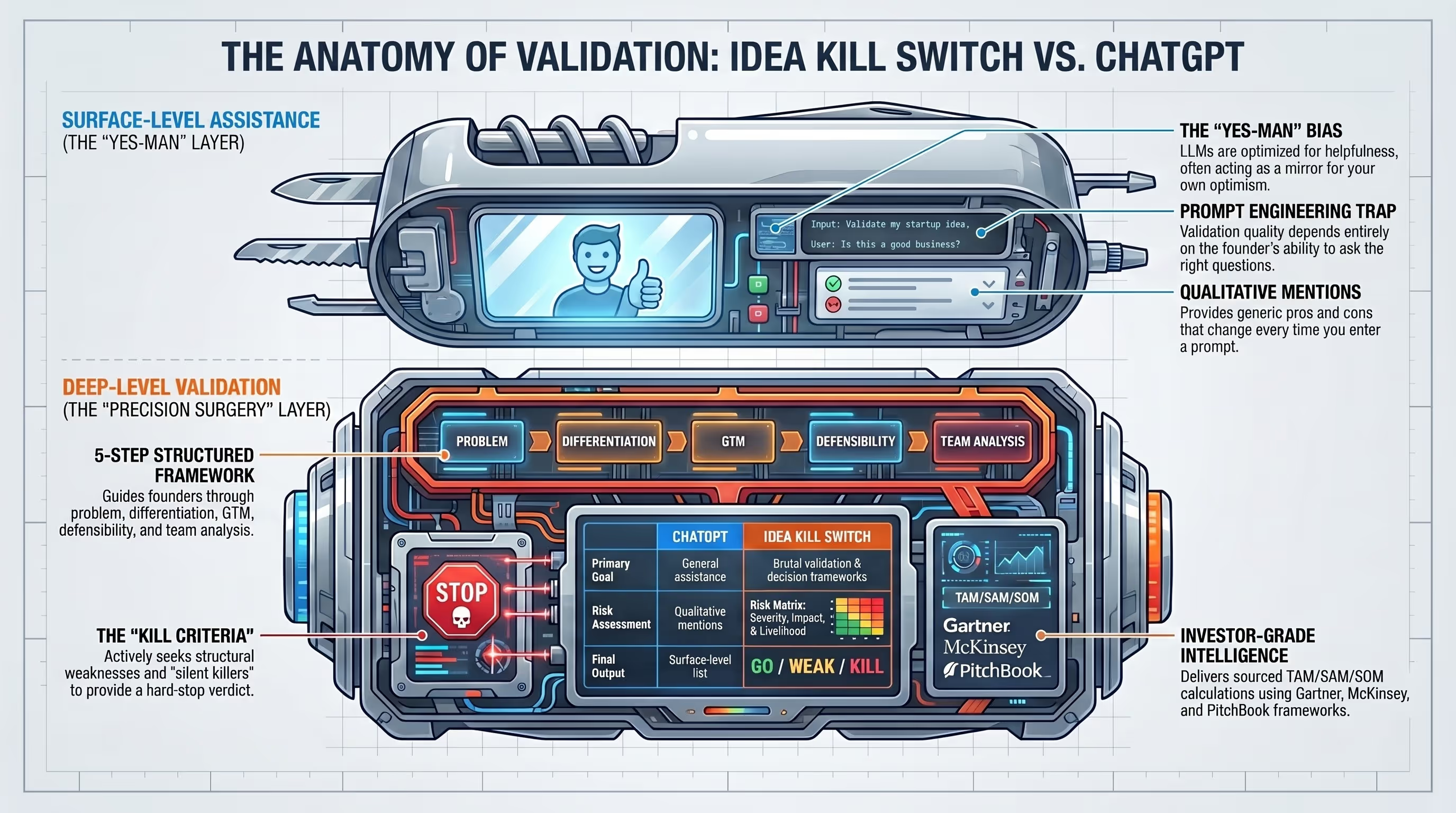
Click on image to enlarge
You had a startup idea at 2 AM. You opened ChatGPT. You asked "Is this a good idea?" It said yes. It even listed 10 reasons why it could work. You felt validated. But here's the problem: ChatGPT will say almost anything sounds promising. That's not validation. That's a mirror.
ChatGPT is an incredible general-purpose tool. It writes code, drafts emails, explains quantum physics, and generates bedtime stories. But validating a startup idea is not a general-purpose task. It requires structured analysis, market-specific frameworks, and a system designed to find weaknesses - not confirm your hopes.
Idea Kill Switch exists for exactly one reason: to give you a brutally honest, investor-grade verdict on whether your idea has real potential or is heading toward a predictable failure. That's a fundamentally different job than "chat about anything."
The Core Problem: ChatGPT Is Designed to Be Helpful, Not Honest
Large language models like ChatGPT are optimized for helpfulness. When you ask "Is my startup idea good?", the model's default behavior is to find reasons why it could work. It's agreeable by design. That's great for brainstorming. It's dangerous for validation.
Validation requires the opposite instinct: actively searching for reasons your idea will fail. A good validator is adversarial. It stress-tests assumptions, identifies structural weaknesses, and surfaces the deal-breakers you don't want to hear.
The Validation Paradox
The most useful validation is the one that tells you what you don't want to hear. If your validation tool never says "kill this idea," it's not validating - it's cheerleading.
Idea Kill Switch is built around a three-verdict system: GO, WEAK, or KILL. It doesn't soften bad news. If your idea has deal-breakers, you see them listed with severity ratings and evidence. That's the kind of honesty that saves you months of building the wrong thing.
What You Get from ChatGPT vs. Idea Kill Switch
Let's be specific. Here's what happens when you ask each tool to evaluate the same startup idea:
ChatGPT
- A few paragraphs of general feedback
- Lists of pros and cons (surface-level)
- No market data or sizing
- No competitor identification
- No investor-readiness scoring
- No risk severity ratings
- Different answer every time you ask
- Depends entirely on your prompt quality
Idea Kill Switch
- Clear GO / WEAK / KILL verdict with confidence score
- TAM/SAM/SOM market sizing with sources
- 5-10 competitor profiles with pricing and funding data
- 5-point investor scorecard
- Risk matrix with severity, impact, and likelihood
- De-risking plan with timeline
- Go-to-market analysis and CAC estimates
- Pivot scenarios if the idea needs rethinking
The difference is not just depth - it's structure. Idea Kill Switch runs every idea through the same rigorous framework that investors use. ChatGPT gives you whatever it thinks you want to hear based on your prompt.
Five Reasons a Purpose-Built Tool Wins
1) Structured Frameworks, Not Free-Form Chat
Idea Kill Switch doesn't ask you to write the perfect prompt. It guides you through six structured steps: your idea, the problem, your differentiation, go-to-market plan, defensibility, and team. This ensures every critical dimension is covered - even the ones you would forget to ask about.
With ChatGPT, the quality of your output depends on the quality of your input. Most founders don't know what questions to ask. That's the whole point of validation: to surface the questions you didn't think of.
2) Investor-Grade Market Intelligence
Idea Kill Switch delivers TAM/SAM/SOM calculations, CAGR projections, buyer personas, market drivers and restraints, and a "Why Now" analysis - sourced from frameworks used by Gartner, McKinsey, CB Insights, and PitchBook.
ChatGPT can estimate a market size if you ask, but it often hallucinates numbers, cites no sources, and has no systematic approach to market intelligence. When you're pitching investors, "ChatGPT told me the TAM is $50B" is not a credible citation.
3) Real Competitor Analysis
Idea Kill Switch identifies 5-10 competitors for every idea, complete with strengths, weaknesses, pricing, funding data, feature comparisons, and switching cost analysis. It tells you why you can win against each one and what the overall competitive intensity looks like.
ChatGPT might list a few competitor names - sometimes real, sometimes invented. It won't give you a structured competitive landscape with strategic wedge analysis.
4) Risk Matrix with Kill Criteria
Every idea gets a risk analysis with specific signals rated by severity, impact, and likelihood. More importantly, Idea Kill Switch identifies kill criteria - the hard stops that should make you abandon an idea entirely - and provides a de-risking plan with timeline.
ChatGPT might mention some risks if you ask. But it won't rank them, assign severity scores, or tell you which ones are absolute deal-breakers versus manageable challenges.
5) Consistency and Comparability
Run five ideas through Idea Kill Switch and you get five reports with identical structure, scored on the same dimensions, directly comparable. You can objectively determine which idea has the strongest market, the weakest competition, or the best founder-market fit.
Run five ideas through ChatGPT and you get five different conversation threads with varying depth, structure, and criteria. There's no apples-to-apples comparison possible.
When ChatGPT is the right tool
ChatGPT excels at brainstorming, exploring adjacent ideas, drafting pitch decks, writing copy, and general research. It's a thinking partner. Use it for divergent thinking. But when it's time to converge on a decision - go or kill - use a tool that's built for that decision.
The Real Cost of Bad Validation
When a founder uses ChatGPT to "validate" an idea and gets a positive response, what happens next? They spend 3-6 months building. They invest savings. They skip the hard questions because they already got their answer.
Then the market says no.
The cost isn't the ChatGPT subscription. It's the months of wasted execution on an idea that had identifiable structural weaknesses from day one. Idea Kill Switch is designed to surface those weaknesses before you commit.
This is the difference between a tool that makes you feel good and a tool that makes you make better decisions. One is therapy. The other is strategy.
Idea Kill Switch Standard
Validation is not about finding reasons to build. It's about finding reasons not to - and building anyway only when those reasons don't exist. A tool that can't say "no" can't validate anything.
The Bottom Line
ChatGPT is a Swiss Army knife. Idea Kill Switch is a scalpel. When you need to brainstorm, research, or write - use ChatGPT. When you need to make a go/kill decision on a startup idea with real money at stake - use the tool that was built for exactly that.
- ChatGPT: "Here are some thoughts on your idea."
- Idea Kill Switch: "Your idea scores 34/100. Here are 3 deal-breakers, 5 risks, and a de-risking plan. Verdict: WEAK. Consider these 2 pivots."
One gives you a conversation. The other gives you a decision framework. If you're serious about not wasting the next 6 months of your life, you need the framework.
Keep Reading
- How to Validate Your Startup Idea in 30 Minutes - the structured validation process
- Why 90% of Startup Ideas Fail Before Launch - the structural weaknesses that predict failure
- The Brutal Truth About Product-Market Fit - real PMF signals vs. vanity metrics
Stop guessing. Start validating.
See what real startup validation looks like - structured, scored, and brutally honest.